David Négri, known as SkunkDog, is a painter whose work is built at the crossroads of the street, music, and a freedom of expression embraced as a vital necessity. A child of the punk era, he grew up immersed in the poetic rebellion of Bob Dylan and the sovereign insolence of Patti Smith — from whom he borrowed his artist name, SkunkDog, the “skunk dog,” as both a manifesto and a tribute.
From an early age, books, music, and the rejection of conventions shaped the contours of a deeply personal universe that he would spend his life exploring. Armed with pencils and brushes, he threw himself body and soul into a creative adventure without safety nets, driven by an energy as raw as it was insatiable.
His painting bears the marks of this journey. Mixing earth, coffee, and resin, he scratches and scars his canvases until they resemble city walls — constantly tagged, erased, overwritten — living palimpsests of urban memory. These surfaces become spaces of projection, absorbing his emotions, cultural references, memories, fragments of poems, and discoveries gathered while wandering through alleyways.
Yet while his visual language was born in the street, his subjects belong to a far broader territory. The characters and figures inhabiting his canvases do not attempt to imitate the visible world — they are its distorted echo, reinterpreted and mythologized. SkunkDog draws from the vast reservoir of myths and collective sensibilities, which he revisits in his own way through bold planes of color and dense symbolism, creating works that speak as much to instinct as to the eye.
This Baumettes prison door appears as a true visual mind map — dense, abundant, almost overwhelming — where the eye scarcely knows where to settle, as every inch seems inhabited. Executed in shades of black and beige, the work unfolds a raw and instinctive graphic universe somewhere between urban graffiti, surrealist automatic drawing, and spontaneous writing. The energetic, nervous lines seem to have been laid down in a trance-like state, as though dictated by an inner urgency. The whole composition conveys a tension between confinement and freedom, between scream and whisper — as if the door itself had absorbed, over time, all the words that could never be spoken aloud.
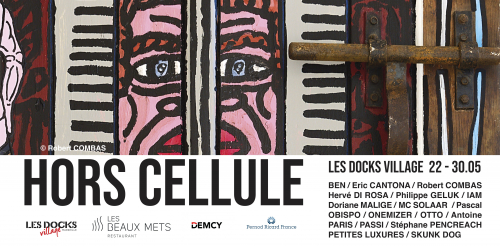
HORS CELLULE
22 May 2026 - 30 May 2026